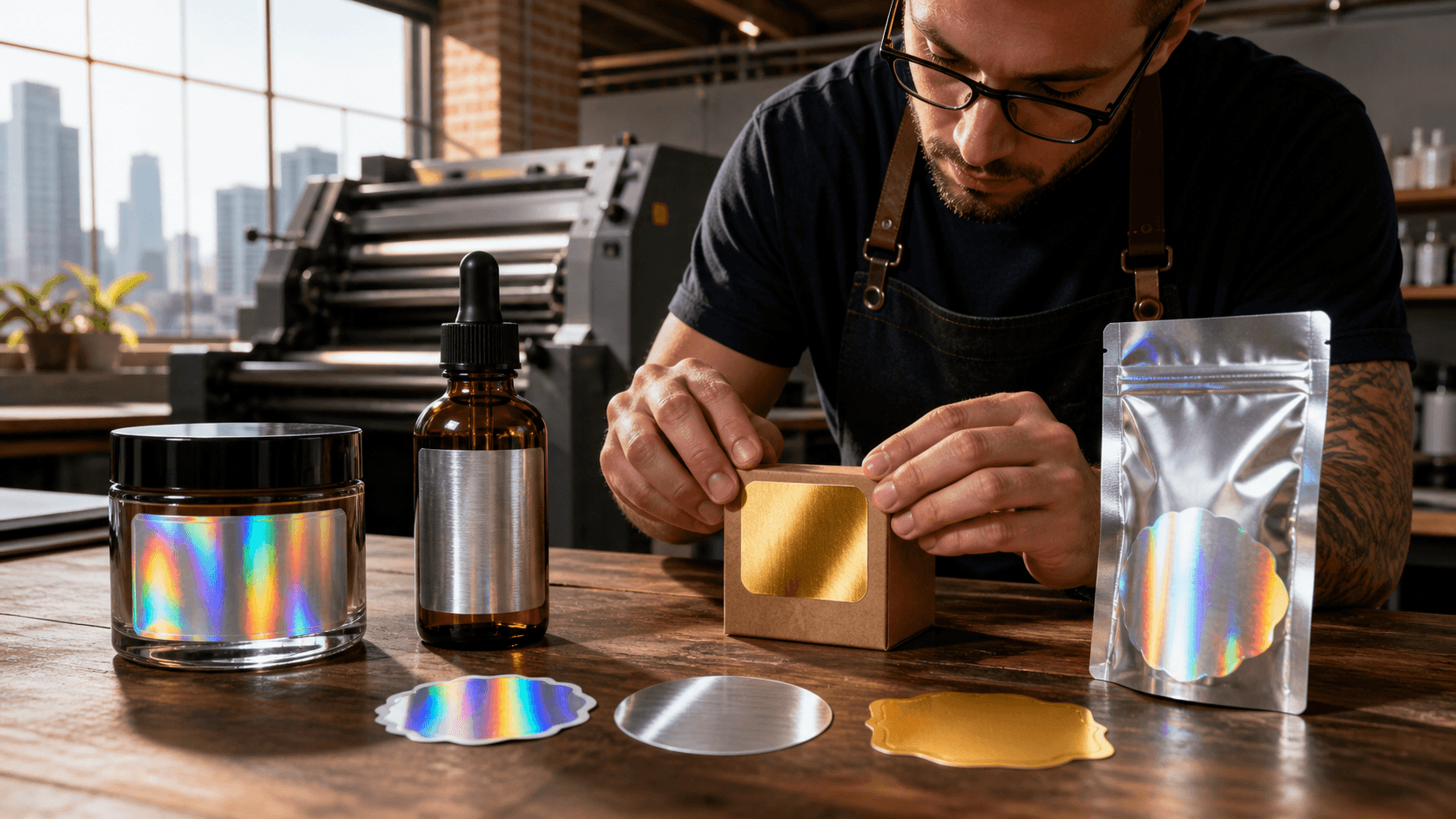
Make Everyday Packaging Catch the Eye
Holographic and foil details can make a label or sticker feel more noticeable without changing the heart of your brand. A simple logo, product name, icon, or short message can take on a new look when light reflects across it.
Compared with an everyday printed label, a reflective sticker or metallic detail gives the design another layer of visual interest. That can be useful when your packaging sits on a shelf, travels in a shipment, or is handed out at an event. These finishes are not needed for every project, but they are worth considering when presentation matters as much as the information on the label.
At IPS Detroit, we design and print in-house at our Detroit shop. We work with local customers who use free pickup, and we ship custom print products nationwide.
Holographic and Foil Effects Fit Different Goals
Custom holographic stickers have a reflective surface that shifts through different colors as the sticker moves in the light. The effect can feel bright, playful, futuristic, or bold, depending on the artwork. It is often a good match for colorful branding, limited-run packaging, eye-catching artwork, and designs meant to be noticed quickly.
Foil works differently. Custom foil labels offer a metallic look that can add a polished detail to your packaging while keeping the overall artwork clean and easy to read.
When choosing between the two, start with your existing brand style:
- Holographic can fit energetic artwork, bright colors, and bold graphics.
- Foil can fit simple layouts with one focused metallic detail.
- Either option works best when the main message remains clear at a glance.
- Your label size and where it will be seen should guide the final choice.
We recommend thinking about the colors already in your logo and how much attention the sticker needs to grab. A busy design may not need more visual movement, while a simple mark can benefit from a reflective feature.
Where Custom Holographic Stickers Earn Their Place
Product packaging is one of the most practical places to use custom holographic stickers. A reflective logo or label can bring extra attention to coffee bags, candle jars, bakery packaging, cosmetics, skincare products, beverage labels, and online order packaging. The goal is not to make every package loud. It is to give customers one clear detail they recognize on a shelf, at a market table, or when opening a shipment.
Individual die-cut stickers are also useful as brand extras. We can create die-cut stickers in custom shapes, making them a good fit for order inserts, pop-up handouts, and items customers may place on laptops, water bottles, notebooks, or other personal belongings. Keep the artwork readable at the size you plan to print. Tiny type and crowded details can get lost, even on a standout material.
Events are another natural fit. Holographic and foil stickers can work well for product launches, conferences, fundraisers, wedding favors, and party packaging. For an event design, we suggest giving priority to the event name, a date when needed, and one clear visual focus. Too much text can make a small sticker hard to understand.
Artwork Choices That Let Reflective Details Stand Out
Simple, high-contrast artwork usually gives holographic and foil materials the most room to work. Bold shapes, clear type, open space, and recognizable logos are often easier to notice than a layout filled with small details. Treat the reflective area as a feature, not something every part of the design has to compete with.
File setup matters, too. Raster artwork should be built at 300 DPI, while vector files are especially helpful for logos and sharp lettering. We also recommend including bleed around the outside edge, keeping important wording inside the safe zone, and providing clear cut lines for custom die-cut shapes.
A few planning points can help before artwork goes to print:
- Use strong contrast between text, graphics, and the background.
- Avoid placing tiny wording near the cut edge.
- Leave enough open space around your main logo or message.
- Discuss clear and white ink options early if solid white areas or stronger color coverage matter to the design.
White ink can be especially useful when you need bright white areas or colors that look more solid. Every order receives a proof before printing, so you have the opportunity to review the layout, wording, size, and overall look before production begins.
Formats and Finishes That Support Your Workflow
Roll labels can make sense when you apply the same design again and again across jars, bottles, bags, boxes, or other packaged goods. For businesses packing products in batches, rolls can keep labeling organized and ready for repeated application.
Individual die-cut stickers are often a better choice for handouts, inserts, giveaways, and artwork that needs a custom outer shape. A sticker shaped around your logo or graphic can feel more like a branded item than a standard rectangle.
The finish you choose also affects the final look. Gloss laminate creates a shiny surface, while matte laminate has a softer, less reflective appearance. If your artwork includes holographic or foil elements, consider whether you want the rest of the design to look polished and bright or more muted and understated. The best choice is the one that supports your brand instead of competing with it.
Plan Your Next Label or Sticker Order
Before pricing a project through our instant quote tool, gather your logo or finished artwork, preferred label size, quantity, and format. Decide whether you need roll labels for packaging or individual stickers for handing out, then note any holographic, foil, gloss, matte, clear ink, or white ink details you want to discuss. Design is separate from printing, and we offer logo design for a flat $35. After proof approval, production takes 1 to 2 business days.
Detroit and Metro Detroit customers can use free local pickup from 8942 W Fort St, Detroit, MI 48209, while orders can also ship nationwide. The clearest path is to choose a finish that supports your logo, keep the artwork easy to read, and give the reflective detail one job: making the right part of your design stand out.
Bring More Attention to Your Design
See how custom holographic stickers can add a reflective finish to labels, packaging, and promotional designs without making the artwork harder to read. At IPS Detroit, we review a proof before printing so you can check the finish, layout, and details first. If you need help choosing between holographic and foil, contact us and our team can help you plan your order.